Even in the sciences, you only begin to see the phenomenon in the sky or under the microscope if someone first describes what you are looking for. We need instructions in the art of seeing. Then the invisible becomes suddenly visible, right in your squinting eye. – pg 108. School day and nightmares, The Souls Code James Hillman, Bantam 1997
Most of us don’t realise how much of our seeing is habitual. We don’t just look at the world — we filter it through memory, expectation, and belief. What if we could learn to see differently?
Seeing with new eyes is not about changing the world outside, but about shifting the lenses within. When we alter the frame of perception, reality itself appears to change. Colours brighten, patterns reveal themselves, and possibilities open where before there seemed to be none.
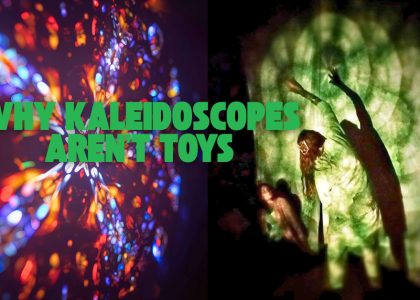
Light helps us do this. Kaleidoscopic geometry and colour sequences disrupt the automatic pathways of vision. They invite us into curiosity, forcing the brain to reorganise how it processes pattern and depth. Suddenly, what was familiar looks alive again.
This is more than a visual trick. It is a practice of perception. To see with new eyes is to invite creativity, empathy, and presence. It is to step out of the narrow corridors of routine and into the wide spaces of imagination.
When clients sit before a kaleidoscopic projection, they often describe the same feeling: “I didn’t know I could see like this.” That shift in perception becomes a metaphor for life. If we can learn to see light in a new way, we can also learn to see ourselves, and each other, differently.
To learn to see with new eyes is to remember that perception itself is creative. And when we change how we see, we change how we live.
👉 Read Next: Light as Art — exploring how light and creativity weave together to open perception even further.