The Geometry of Seeing

One shift in relationship. An entirely new pattern.

An exploration of how light, mirrors and movement create extraordinary patterns, and what these changing relationships reveal about the way we see.

What Creates the Pattern?

A kaleidoscope reveals something fascinating about the nature of relationships.

A single piece of coloured glass does not contain the complete pattern. Neither does a mirror or a beam of light.

Yet bring them together in a particular arrangement, introduce movement, and something extraordinary becomes visible.

The mirrors establish the geometry. Light reveals colour and form. Movement changes the arrangement.

With every small shift, the entire image can reorganise.

The beauty lies not simply in the individual components, but in what becomes possible through their interaction.

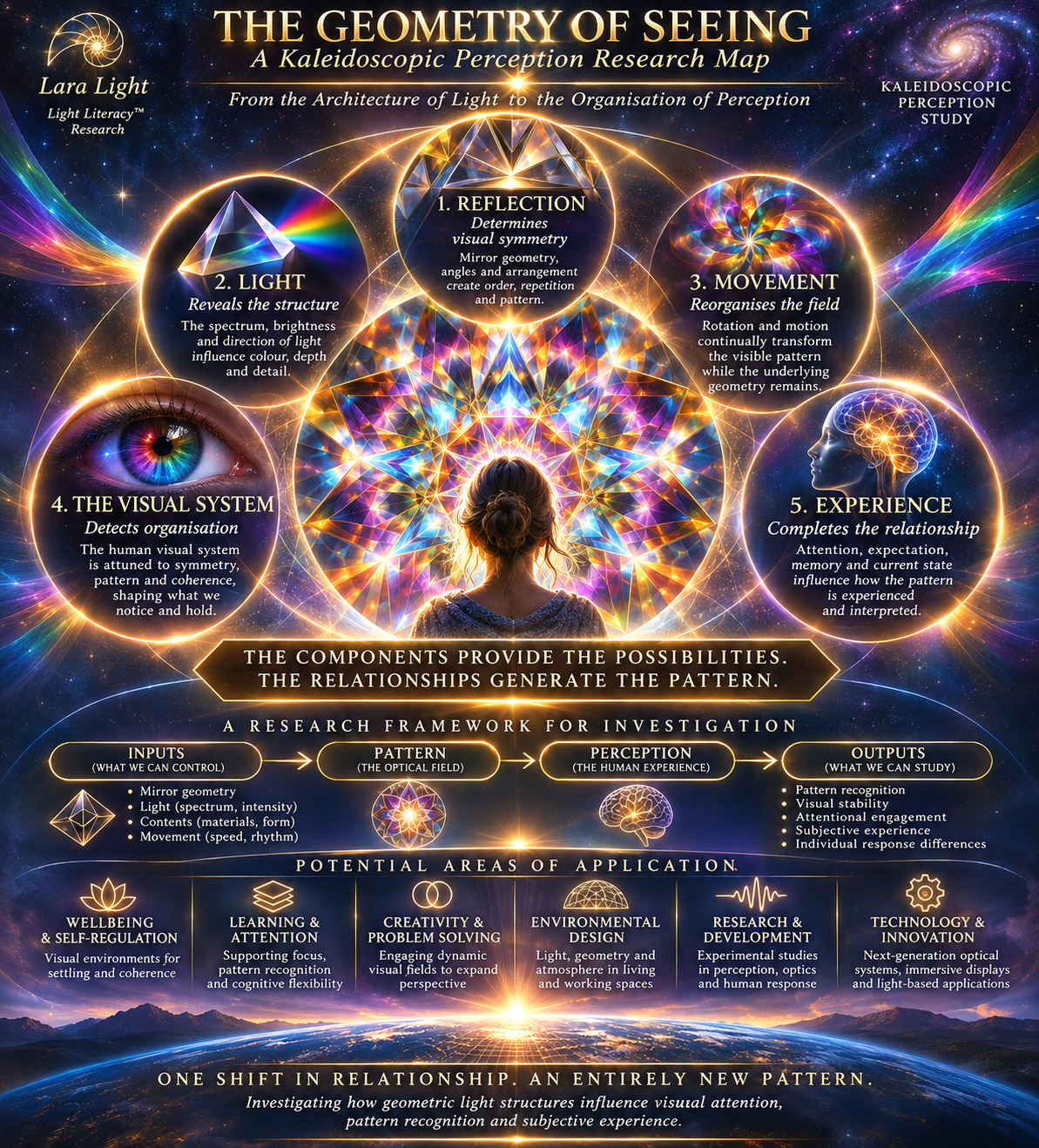
“The components provide the possibilities. The relationships generate the pattern.”

— On the Mechanics of Symmetry

As the arrangement changes, so does the pattern.

In some kaleidoscopes, fragments of glass, crystals or other materials shift and settle with movement. In others, the optical elements themselves move, transforming the relationships between light and reflection.

What appears to be a single, unified image is actually the result of many interacting reflections, colours and geometric relationships.

And here lies something fascinating: the underlying optical principles remain consistent, even as the visible pattern changes completely.

The structure provides continuity. Movement introduces possibility. Each new relationship reveals another way of seeing.

Optics & Interpretation

Five Relationships That Shape What We See

Light, reflection and movement create the patterns we encounter. Our visual system recognises their structure, while attention, memory and experience influence what we make of them.

These five relationships offer a way to explore the journey from optical geometry to human perception.

01 / Physics

Reflection

The geometry of symmetry. Mirrors multiply and arrange reflected images according to their angles and positions, creating recognisable patterns from simple visual elements.

02 / Spectrum

Light

The source of colour and visibility. Different wavelengths, intensities and lighting conditions influence the colours, contrasts and details we perceive within a pattern.

03 / Dynamics

Movement

The principle of transformation. As materials or optical elements move, their relationships change, allowing new patterns to emerge while the underlying optical principles remain consistent.

04 / Biology

The Visual System

Recognising order and structure. Our visual system processes colour, contrast, edges, movement and symmetry, helping us organise complex visual information into recognisable forms.

05 / Cognition

Experience

Where seeing becomes personal. Attention, memory, expectation and individual experience influence what we notice, how we interpret patterns and the meaning we give to what we see.

From physical light to personal experience: each relationship contributes to what becomes visible, recognisable and meaningful.

Mapping the Geometry of Seeing

🔍 Click map artwork to expand interactive schematic detail
This map brings together established optical relationships and developing research questions about visual perception. It is a framework for enquiry, not a claim that all proposed effects have been scientifically demonstrated.
Foundational Inquiry

Questions Worth Exploring

The way we see is shaped by more than the light entering our eyes.

Geometry, colour, movement, attention and previous experience all contribute to how we perceive the world around us.

Through my work with kaleidoscopic light, I’ve become interested in five questions that connect the physical behaviour of light with the human experience of seeing.

01

Symmetry and pattern recognition

How does the visual system recognise symmetry, and why do some geometric arrangements attract our attention more readily than others?

02

Colour and visual response

How do changes in colour, brightness and spectral composition influence what we notice, how comfortable we feel and how we experience a visual environment?

03

Movement and perceived stability

What happens to our sense of visual stability when patterns move, rotate or continually reorganise? How does the speed of change influence our experience?

04

Visual complexity and attention

At what point does a complex visual pattern become engaging, confusing or overwhelming? How do different levels of complexity influence our ability to sustain attention?

05

Individual differences in perception

Why can two people encounter the same pattern yet notice different details, form different associations or describe entirely different experiences?

Each question opens another way of investigating the relationship between the patterns we encounter and the experience of seeing.

ELEVATING THE OPTICAL EXPERIENCE

From the Kaleidoscope to Perceptual Research

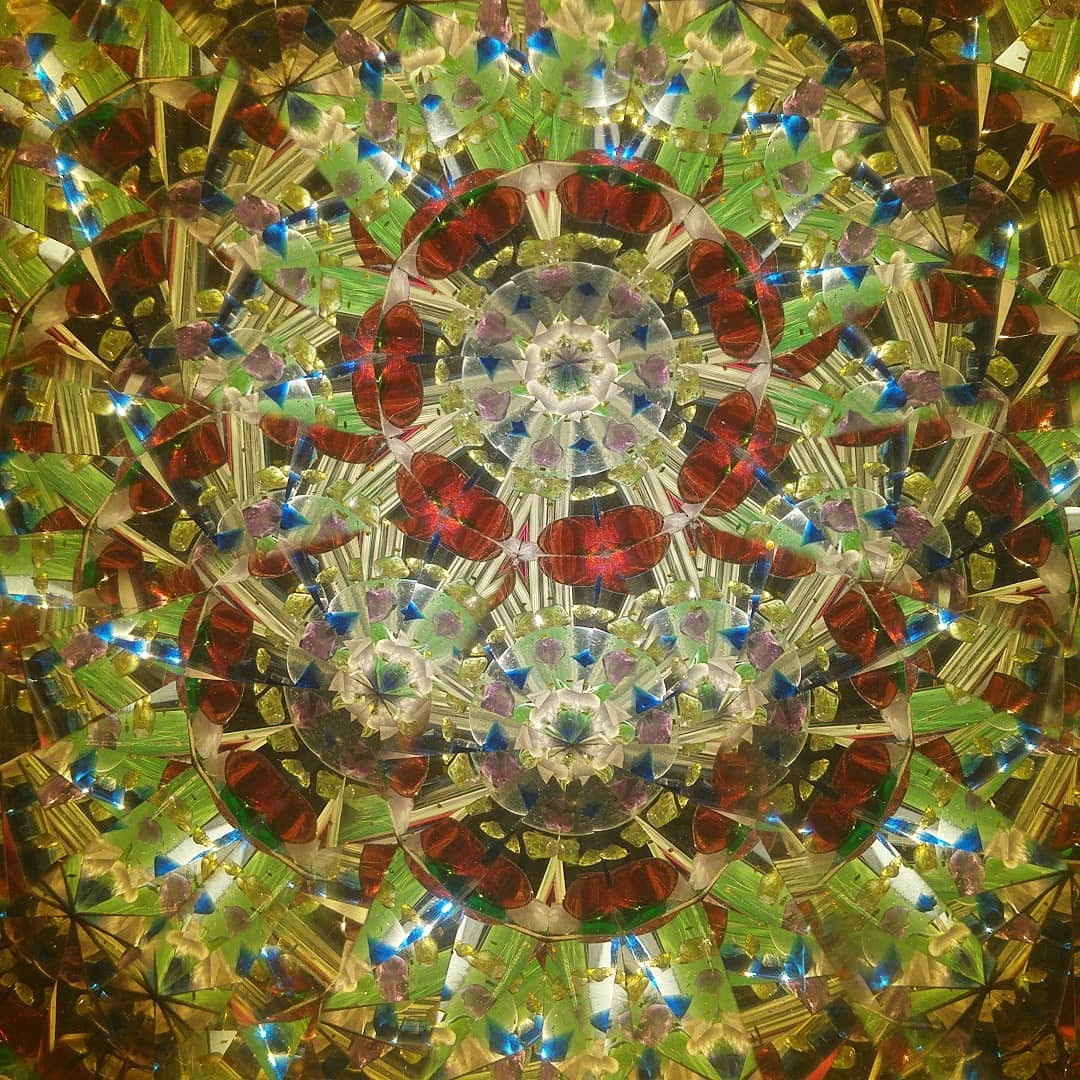
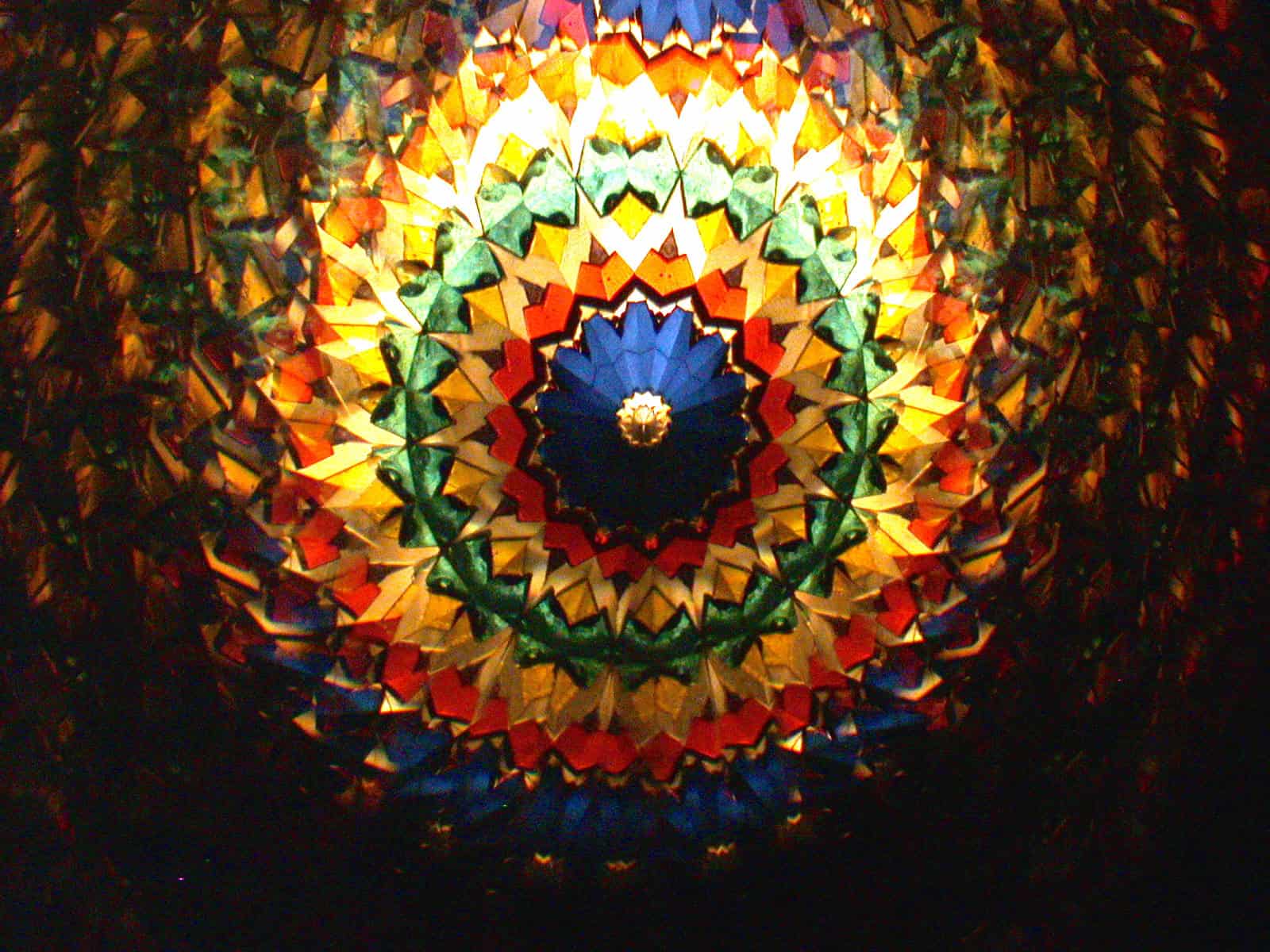
My exploration began at a workbench, making kaleidoscopes.

I was fascinated by how a few simple materials, brought together through light and reflection, could create an extraordinary diversity of patterns.

Over time, my curiosity moved beyond the objects themselves.

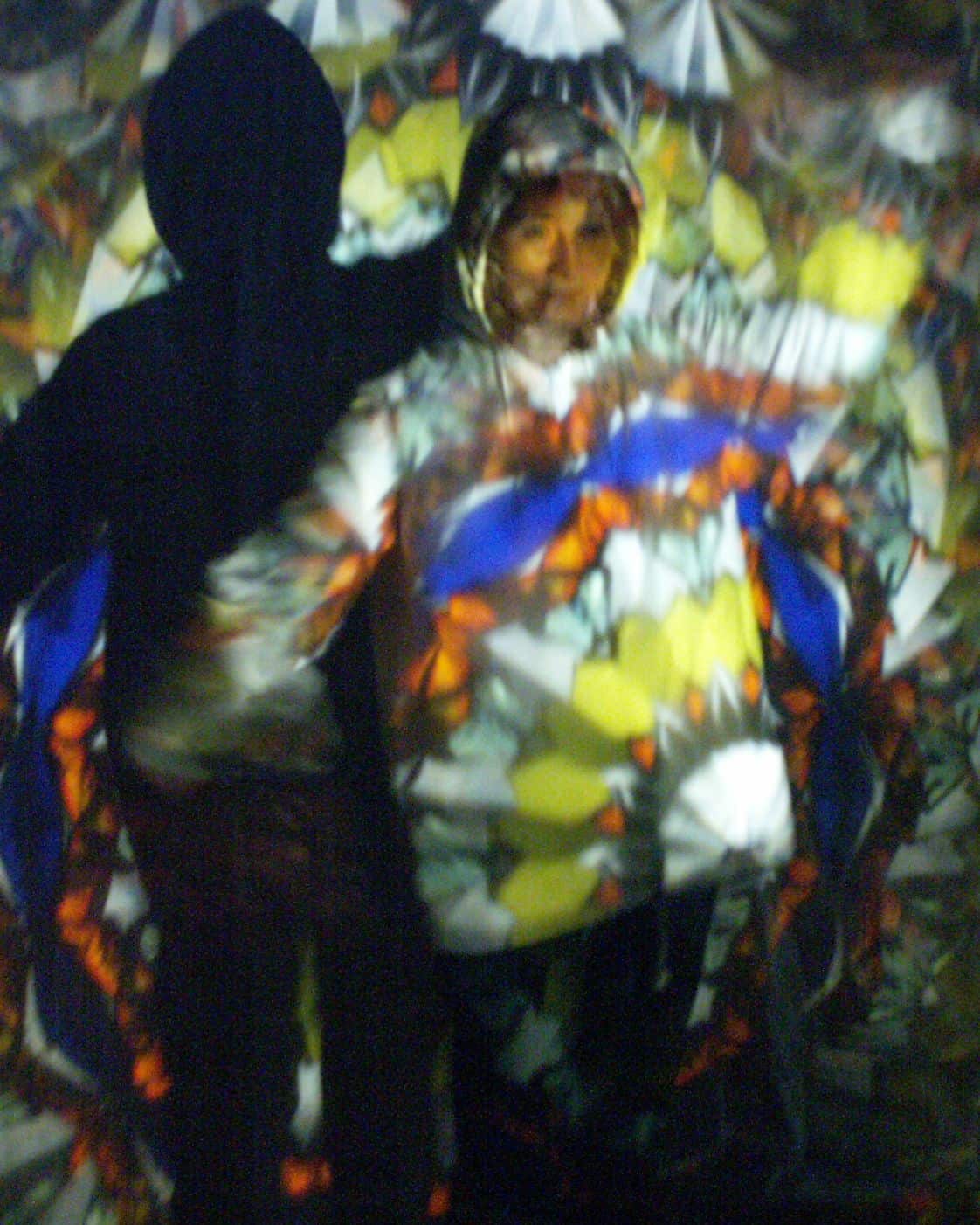
I began exploring what happened when those intricate patterns were projected into larger spaces, surrounding people with moving fields of colour and geometric light.

And something else began to interest me.

The optical patterns followed recognisable physical principles, yet the people experiencing them noticed different things. Some were drawn to colour, others to symmetry, movement or particular forms.

This opened a deeper line of enquiry into the relationship between what is physically presented and what is personally perceived.

Today, that curiosity continues through my work with kaleidoscopic light, Light Literacy™ and the developing investigation into the geometry of seeing.

What began as an exploration of light became an exploration of perception.
01 / The Making

Exploring light through materials, mirrors and geometry.

02 / The Experience

Exploring what happens when patterns become an environment. By projecting these complex crystalline matrices into entire physical rooms, we stepped inside the kaleidoscope itself. This expansion from a tiny viewport to a fully atmospheric environment allowed us to study how scale, light projection, and spatial geometry shape actual cognitive human perception.

Continue Exploring

Research Library

Explore scientific studies, historical discoveries and emerging questions about light, colour, symmetry and human perception.

How I Explore These Questions

An introduction to the methods, observations and critical thinking that guide my exploration of light, optical geometry and perceptual experience.

The World of Kaleidoscopes

Discover the fascinating history of the kaleidoscope, the principles of reflection and symmetry, and the extraordinary visual possibilities of this remarkable optical instrument.

Lara Light | Light Literacy™ Research