
Before the waking mind structures the world into boundaries and named forms, there exists an unmapped interval, a sudden suspension of shadow where light does not merely illuminate, but speaks. This is the calibration of the senses, the quiet overture to Lara Light’s visual philosophy. Here, looking becomes an immersive act of presence.
PROLOGUE
There are moments in life when the familiar light shifts,
when something interior becomes visible, when the world seems to pause as if asking you to listen differently.
This book began in one of those moments.
I had spent years moving through my own thresholds, quiet dis solutions, necessary endings, the slow release of patterns that no longer fit. What I thought was breaking me was, in truth, clearing space for something more coherent to take form. I did not know it then, but the work that follows was already gathering beneath the surface, shaped through experience long before it found its name.
Light became my first teacher.
Not as metaphor, but as presence, a quality of awareness that revealed what I had avoided
and illuminated what I longed to reclaim.
During this time, I could not explain why color affected me so deeply.
All I knew was that certain hues stirred memory, softened emotional tension, or opened up a sense of inner space I had not felt in years. Slowly, something
became clear: My body responded to light in ways my mind had not yet learned
to name.
It reflected what was bracing and revealed what was tender. It spoke in sensation when words were too small.
The experiences that shaped these pages did not unfold in a straight line.
They moved in cycles of insight, contraction, release, and a return to deeper clarity. Each time I thought the path had reached its end, another layer came forward, asking to be met with more honesty and more presence. This is the nature of inner work: a returning, again and again, to the places that ask for light.
Over the course of this journey, there have been moments in my life where I felt I was witnessing something I could see but did not yet have language for, something that revealed itself through the people I worked with. In those special instances when someone would see themselves clearly for the first time in years, the shift was immediate, undeniable, and often fleeting. I remember being struck by the quiet power of those moments, and by the profound visual beauty of the way the work could move through a person.
And there were moments that dismantled me, teaching patience, humility, and a quieter form of strength. Through all of it, light remained the constant thread. Not a solution, but a way of perceiving: a way of coming back into contact with myself.
The chapters ahead are not here to tell you who you are. They are here to support you in meeting yourself with clarity, compassion, and depth.
My story woven through these pages is here to remind you that transformation is not abstract. It is lived. It is embodied. It takes shape through breath, sensation, and the choices we make when life asks us to respond differently.
So take your time.
Let the ideas settle.
Let your body respond.
Let the light show you what is ready.
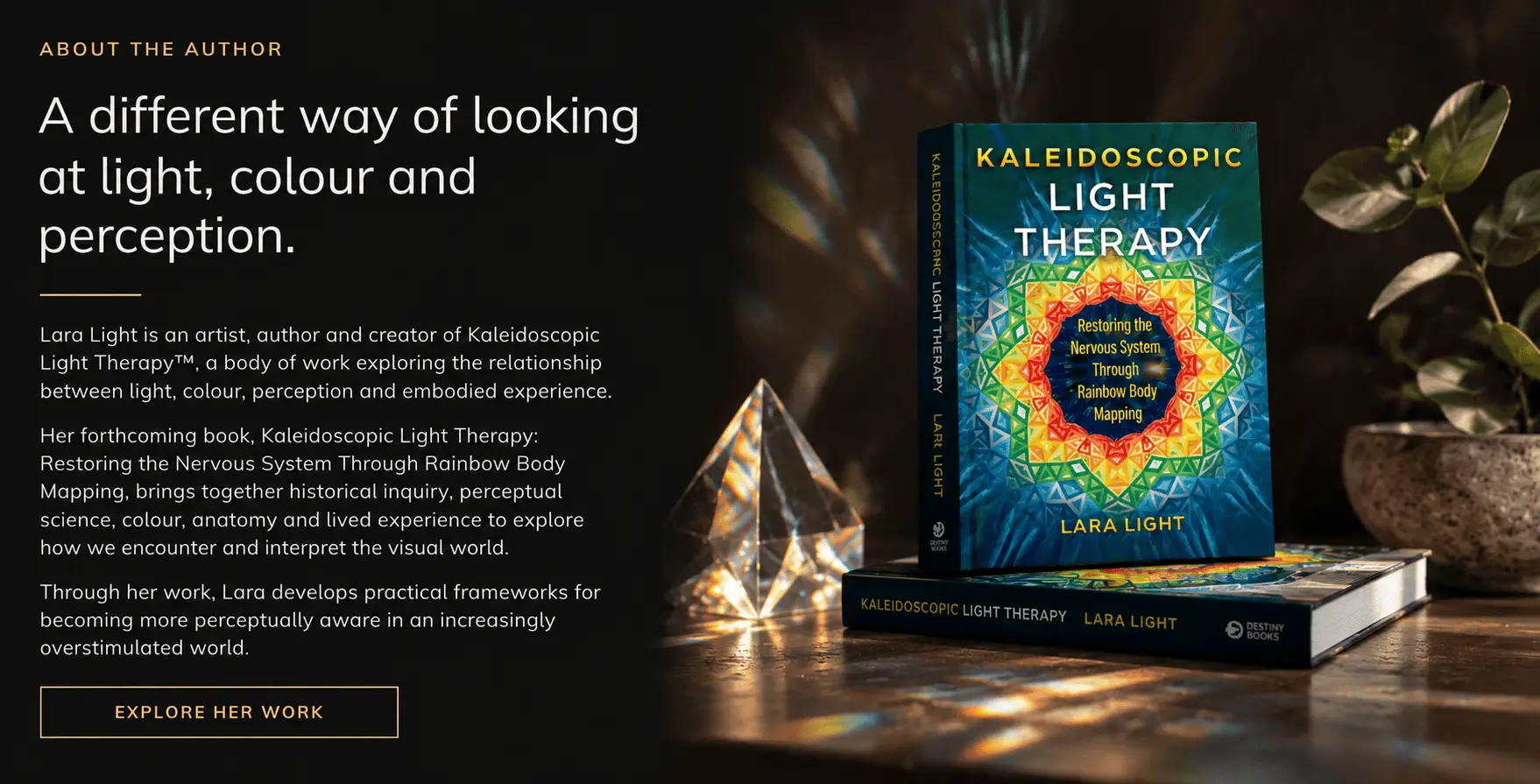
This is where the journey begins. Not with another system to believe in, but with an invitation to notice.
The work that follows grew from a simple question: what changes when we begin to pay attention to the way we perceive? Light, colour, pattern, sensation and memory are not separate experiences. They meet within us, shaping what we notice, what we feel, and how we move through the world.
Over time, this became the foundation of what I now call Light Literacy™: learning to recognise the language of light and colour, to notice our own perceptual patterns, and to become more conscious of the relationship between what we see and how we experience.
Kaleidoscopic Light Therapy is one expression of that larger exploration.
So as you enter these pages, I invite you to do more than read. Notice what happens in you. Notice what catches your attention. Notice what shifts. The exploration begins there.